

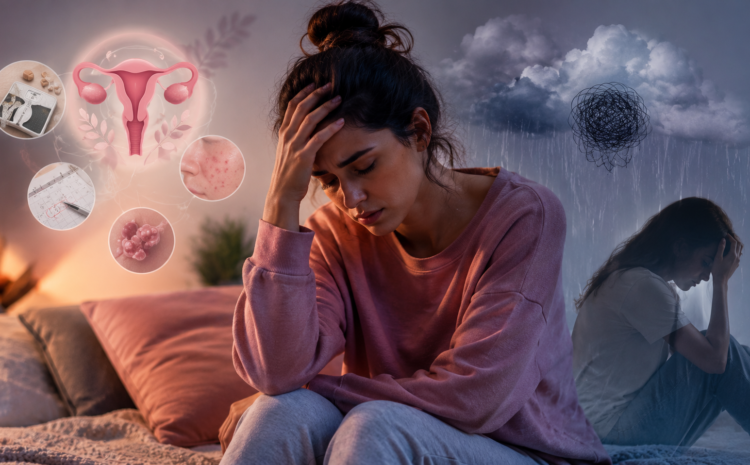
If you have PCOS, you already know it is so much more than irregular periods or a hormonal imbalance on a lab report. What far fewer people talk about and what far too many women carry alone is the emotional weight that comes with it. The anxiety that hums beneath the surface. The low moods that don’t seem to have a clear reason. The mood swings that feel disproportionate and confusing. Research consistently shows that women with PCOS experience anxiety and depression at significantly higher rates than the general population, and yet the psychological dimension of this condition is still routinely underaddressed in clinical settings. This blog is here to validate what you feel, explain the science behind it, and offer a compassionate path forward.
The PCOS–Mental Health Connection: What the Research Says
The link between PCOS and mental health is not incidental it is deeply biological. The same hormonal and metabolic disruptions that drive the physical symptoms of PCOS also directly affect the brain chemistry responsible for mood, motivation, and emotional regulation. Understanding this connection can be genuinely liberating, because it reframes what you’ve been feeling as a medical reality rather than a personal failing.
Here is what the research consistently shows:
- Women with PCOS are up to three times more likely to experience depression and anxiety compared to women without the condition, with some studies placing the prevalence of anxiety in PCOS women as high as 60 to 70 percent figures that rarely appear in the standard PCOS conversation.
- Elevated androgens (male hormones like testosterone that are disproportionately high in PCOS) interfere with the balance of estrogen and progesterone, both of which play critical roles in regulating serotonin and dopamine the neurotransmitters most associated with mood stability and emotional resilience.
- Insulin resistance, which underlies PCOS in a large proportion of women, disrupts blood sugar regulation in ways that directly affect brain function, producing symptoms that overlap significantly with anxiety and depression including fatigue, irritability, poor concentration, and low mood.
- Chronic low-grade inflammation, a hallmark of PCOS, is increasingly recognized in psychiatric research as a significant contributor to depressive illness the same inflammatory pathways that affect your ovaries and metabolism are affecting your brain.
- The visible symptoms of PCOS acne, hair thinning, unwanted facial hair, and changes in body weight carry a substantial psychological burden that compounds the biological drivers, creating a layer of shame and social anxiety that the hormones alone don’t fully account for.
Anxiety and PCOS: Why You Feel Constantly on Edge
PCOS anxiety is not simply worry or overthinking it has specific physiological roots that make it more persistent and harder to rationalize away than ordinary stress. When your hormones, blood sugar, and stress-response system are all dysregulated simultaneously, your nervous system is effectively running on high alert much of the time.
Here’s what’s driving that feeling:
- Cortisol dysregulation is common in PCOS your stress hormone system is often overactive, meaning your body is more reactive to perceived threats and slower to return to a calm baseline after a stressful event.
- Blood sugar crashes caused by insulin resistance can produce physical sensations racing heart, shakiness, sudden dread that closely mimic a panic attack, and these episodes are frequently misidentified as purely psychological when they are partly metabolic.
- Fertility anxiety affects a significant proportion of women with PCOS, particularly those who hope to conceive the uncertainty around ovulation, the fear of infertility, and the pressure of watching time pass can create a persistent undercurrent of dread that is both real and exhausting.
- Social anxiety linked to body image particularly around skin, hair, and weight changes leads many women with PCOS to quietly withdraw from situations where they fear being seen or judged, which in turn deepens isolation and anxiety.
- Hormonal fluctuation across an irregular cycle means that there is no predictable rhythm of emotional stability to anchor to; the unpredictability itself becomes a source of anxiety, because you genuinely cannot anticipate how you will feel from one week to the next.
Depression and PCOS: More Than Just Feeling Sad
PCOS depression is not simply a reaction to difficult circumstances though those circumstances are real and valid. It is also a neurobiological consequence of the hormonal and inflammatory environment your body is living in. Recognizing this distinction matters, because it removes the burden of self-blame and opens the door to treatment that actually addresses the cause.
What PCOS-related depression often looks like:
- Low serotonin and dopamine — the neurotransmitters most associated with pleasure, motivation, and mood stability are directly influenced by estrogen levels, and the hormonal imbalance in PCOS creates a brain chemistry environment that is genuinely predisposed toward depressive symptoms.
- Fatigue and brain fog, which are extremely common in PCOS, both mimic and amplify depression when you are chronically exhausted and mentally slow, it becomes nearly impossible to access the energy or clarity needed to work through difficult emotions or maintain the habits that support mental health.
- Grief over fertility challenges is a real and underacknowledged dimension of PCOS depression whether you are actively trying to conceive or simply living with the uncertainty of not knowing whether you will be able to, that grief deserves to be named and supported.
- Weight-related depression in PCOS is complicated by the fact that weight change in this condition is often driven by insulin resistance rather than lifestyle choices alone, yet the cultural messaging around body size means many women carry enormous shame about something that is largely outside their control.
- Social withdrawal — gradually declining invitations, pulling back from friendships, and spending more time alone is a common and self-reinforcing pattern in women experiencing PCOS depression, because the energy required for social engagement often feels unavailable.
Mood Swings and Emotional Dysregulation
If you sometimes feel like your emotions are completely disconnected from what’s actually happening in your life intensely irritable over something small, tearful without an obvious trigger, or swinging from okay to overwhelmed within a single day you are not imagining it, and you are not “too sensitive.” Hormonal imbalance and mood are deeply entangled in PCOS, and the emotional volatility many women experience is a physiological reality.
- Estrogen and progesterone fluctuations across an irregular cycle or the absence of a predictable cycle entirely mean that the hormonal scaffolding that normally stabilizes mood week to week is simply not functioning consistently in women with PCOS.
- PMS and PMDD (premenstrual dysphoric disorder, a severe form of PMS characterized by significant mood disruption) overlap considerably with PCOS, and many women experience intense emotional symptoms in the days before an irregular or delayed period.
- Insulin spikes and crashes contribute directly to irritability blood sugar instability affects mood regulation in real time, and for women with PCOS who may be eating in ways that unknowingly worsen these swings, the emotional volatility can feel relentless.
- Feeling “out of control” emotionally and then feeling guilty or confused about those emotions creates a secondary layer of distress that compounds the original mood disruption and erodes confidence in your own emotional judgment over time.
The Vicious Cycle: How PCOS Symptoms and Mental Health Feed Each Other
PCOS and mental health do not simply coexist they actively reinforce each other in a cycle that can be genuinely difficult to interrupt without understanding the loop:
- Chronic stress raises cortisol, which worsens insulin resistance and disrupts ovulation, meaning that psychological distress directly worsens the hormonal picture of PCOS.
- Poor mental health makes it harder to maintain the diet and exercise habits that are among the most effective management tools for PCOS depression in particular drains the motivation needed to cook well, move consistently, or prioritize sleep.
- Sleep disruption, which is extremely common in both PCOS and mood disorders, amplifies inflammatory markers, impairs insulin sensitivity, and reduces emotional regulation capacity simultaneously, deepening both conditions at once.
- Emotional eating in response to stress or low mood affects blood sugar and insulin levels in ways that worsen PCOS symptoms, creating a feedback loop between emotional distress and metabolic disruption.
- Isolation — withdrawing from relationships and community as a coping response removes the social support that is one of the most robust protective factors against both depression and chronic illness progression.
Treatment and Management: Healing Mind and Body Together
Medical and Hormonal Interventions
Addressing the hormonal roots of PCOS emotional health is often an important part of mental health recovery not a replacement for psychological support, but a meaningful complement to it.
- Hormonal therapy, including combined oral contraceptives or progesterone support, can stabilize the hormonal fluctuations that contribute to mood swings and anxiety, and is worth discussing with your gynecologist specifically in the context of your mental health symptoms.
- Metformin, commonly prescribed for insulin resistance in PCOS, has been shown in some research to have modest mood-improving effects likely because reducing insulin resistance and inflammation has downstream benefits for brain chemistry.
- Working with both an endocrinologist and a gynecologist who communicate with each other and who take your psychological symptoms seriously alongside your physical ones is the most effective model of care for hormonal imbalance and mood.
Therapy and Psychological Support
You do not need to be in crisis to deserve psychological support, and therapy for PCOS anxiety and depression is not a last resort it is often one of the most powerful interventions available.
- Cognitive Behavioral Therapy (CBT) has strong evidence for both anxiety and depression, and is also effective for the body image distress, health anxiety, and fertility-related worry that are particularly common in women with PCOS.
- PCOS-specific support groups — whether in person or online offer the profoundly valuable experience of being understood by people who are living the same reality, reducing the isolation that so often accompanies chronic illness.
- Therapists who specialize in chronic illness understand the grief, identity disruption, and cumulative exhaustion that come with managing a lifelong condition, and can offer a depth of support that a generalist may not be equipped to provide.
Lifestyle Strategies That Support Mental Health
Lifestyle is not a substitute for medical or psychological care, but it is genuinely therapeutic particularly for the metabolic drivers of PCOS depression and anxiety.
- An anti-inflammatory, blood sugar–stabilizing diet built around vegetables, whole grains, legumes, healthy fats, and lean protein reduces both insulin spikes and systemic inflammation, addressing two of the primary biological drivers of mood instability in PCOS.
- Regular low-impact exercise — walking, yoga, swimming, or cycling supports insulin sensitivity, reduces cortisol, boosts serotonin and endorphins, and has clinical evidence for reducing both anxiety and depression symptoms in women with PCOS specifically.
- Consistent sleep hygiene, including a regular sleep and wake schedule, limiting screen exposure before bed, and creating a wind-down routine, is one of the highest-leverage interventions available for both PCOS management and mood regulation.
- Mindfulness practices — even brief daily breathing exercises or body-scan meditation measurably reduce cortisol reactivity and help interrupt the anxiety–hormonal spiral that is so common in PCOS.
When to Seek Professional Help
Managing PCOS emotional health is not something you need to do entirely alone, and there are clear signals that it is time to reach out for professional support:
- Persistent low mood or anxiety lasting more than two weeks that does not lift with rest or normal self-care warrants a conversation with your doctor or a mental health professional.
- Inability to carry out daily tasks — including caring for yourself, working, or maintaining relationships is a sign that the level of support you currently have is not sufficient for what you’re experiencing.
- Thoughts of self-harm or hopelessness require immediate professional attention; please reach out to a mental health crisis line, your doctor, or a trusted person in your life as soon as possible.
- Anxiety that consistently interferes with your work, relationships, or ability to leave the house is beyond the range of what lifestyle strategies alone can address, and you deserve targeted treatment.
- Feeling as though PCOS has taken over your entire identity — that you are nothing more than your diagnosis, your symptoms, or your struggles is a sign that therapeutic support could help you reclaim your sense of self.
Emotional Impact of PCOS on Relationships and Self-Image
The emotional weight of PCOS doesn’t stay contained within you it ripples outward into your relationships and how you see yourself in the world.
- Romantic relationships can be strained by unexplained mood swings, low libido (which androgens and depression both affect), fertility anxiety, and the emotional exhaustion of managing a chronic condition that a partner may not fully understand.
- Communication breakdown often happens not from a lack of love but from a lack of shared language many women with PCOS struggle to explain what they are experiencing because they don’t yet have the framework to understand it themselves.
- Body image and self-worth become entangled in ways that are painful and persistent when your skin, hair, or weight feel like visible signs of illness, separating your appearance from your value as a person requires active, intentional work.
- The feeling of “not being enough” — as a partner, a friend, a professional is one of the most quietly devastating effects of chronic hormonal illness, and it is important to recognize it as a symptom, not a truth.
- Rebuilding confidence through PCOS communities, body-neutral therapy, and self-compassion practices is a real and achievable process many women describe a profound shift when they finally feel seen and understood by others who share their experience.
Conclusion
What you feel is real. The anxiety, the low moods, the emotional volatility these are not character flaws or overreactions. They are the documented, scientifically understood consequences of living with a condition that affects your hormones, your metabolism, and your brain chemistry all at once. Your mental health struggles with PCOS are both valid and treatable, and seeking support for them is one of the most courageous and practical things you can do for yourself. You deserve care that sees all of you not just your ovaries or your bloodwork, but your mind, your emotions, and your life. If this resonates with you, please reach out to a healthcare provider who understands PCOS in its full complexity. You don’t have to carry this alone.
Frequently Asked Questions
Q: Does PCOS directly cause anxiety and depression?
PCOS creates biological conditions that significantly increase the risk of anxiety and depression so while the relationship is not quite as simple as a direct cause-and-effect, it is far more than coincidence. Hormonal imbalances, insulin resistance, chronic inflammation, and the psychological burden of managing visible symptoms all contribute to a brain and body environment that is predisposed toward mood disorders. Research shows that women with PCOS are two to three times more likely to experience clinical anxiety and depression than women without it, and that these conditions often improve at least partially when the underlying PCOS is better managed.
Q: Can treating PCOS improve my mental health?
Yes, for many women, effectively managing the hormonal and metabolic aspects of PCOS produces meaningful improvements in mood, anxiety levels, and overall emotional well-being. Stabilizing blood sugar, reducing inflammation, and addressing hormonal imbalances can all have downstream benefits for brain chemistry. However, because the relationship between PCOS and mental health runs in both directions, treating PCOS alone is often not sufficient combining hormonal management with psychological support and lifestyle strategies typically produces the most complete and lasting improvement.
Q: Is it safe to take antidepressants if I have PCOS?
For most women with PCOS, antidepressants prescribed by a knowledgeable doctor are safe and can be an important part of treatment. Some antidepressants, particularly SSRIs (selective serotonin reuptake inhibitors), are well-studied and widely used in women with hormonal conditions. It is important to have an open conversation with your prescribing doctor about your full medical picture, including your PCOS diagnosis, any medications you are already taking, and your goals for treatment. Weight-related side effects of some antidepressants are worth discussing candidly, as this is a particular concern for some women with PCOS.
Q: How do I explain my PCOS-related mood swings to my partner or family?
Start by sharing the biological basis explaining that PCOS affects hormones that directly regulate mood can help partners and family members understand that mood swings are not deliberate or a reflection of the relationship. You might share a reliable article or bring your partner to a medical appointment where a provider can explain the connection. Frame the conversation around what you need from them whether that is patience during difficult days, help with practical tasks that feel overwhelming, or simply acknowledgment that what you’re going through is genuinely hard. Most partners and family members respond better to clear, specific requests than to general expressions of distress.
Q: Are there natural ways to manage PCOS-related anxiety without medication?
Yes, and several have meaningful evidence behind them. A low-glycemic, anti-inflammatory diet stabilizes the blood sugar fluctuations that drive anxiety-like symptoms. Regular moderate exercise particularly yoga and walking reduces cortisol and increases mood-regulating neurotransmitters. Consistent, quality sleep significantly reduces emotional reactivity and hormonal dysregulation. Mindfulness-based stress reduction (MBSR) has demonstrated clinical benefits for anxiety in chronic illness populations. Magnesium supplementation is sometimes recommended by practitioners for anxiety and sleep in PCOS, though you should discuss any supplements with your doctor. These strategies work best as part of a broader approach that also includes appropriate medical care rather than as a substitute for it.